Showing posts with label Malo-lactic. Show all posts

06 January 2012

Merry Christmas to me!

Look what I got today!  My first new pump!  For the winemaker geeks, it's a Waukesha 30 positive displacement pump.  I've never had a new pump before.  I'm so excited!  The funny part is that I have wine to move but I can't use it because the pump doesn't have a plug!  I'd have to raid another piece of equipment so I guess I'll just wait and use the old one.  Oh well!  But still, I am very excited.  It's so clean and shiny!  And it came it box, that officially makes it a present.

Okay, enough drooling from me, back to work.  Work this week involved adding the bentonite to wines that needed to be protein stabilized, a slow process but not difficult.  After mixing the clay with hot water I let the mixture sit overnight so the clay is completely absorbed and I have a creamy looking slurry that feels very slippery.  I then hook Argon gas up to the tank via one of the valves and slowly allow the gas to bubble in causing the wine to turn in the tank.  Finally I stand at the top of the tank and slowly dribble in the slurry.  This can take around half an hour depending on the size of the tank.  Finally I shut off the gas, close up the tank and let the bentonite go to work.  It takes about a week to settle out and as the bentonite passes through the wine the protein compounds will grab on to the clay and be carried to the bottom.  If I remember right there is a charge difference between the clay and the protein and that is what causes the attraction.  Please don't ask me which is negative and which is positive, I can't remember and I would be compelled to call a fellow winemaker and ask.

I also checked the ML's on the inoculated barrels from two weeks ago.  They appear to be starting. Yeah!  I saw sparkling in the barrels and we are starting to get the dots forming at the top of the sheet.  It's amazing what gets me excited is it?

I nearly forgot to tell you, the problem pinot gris has been stopped.  Mary and I decided it had come into balance though it wasn't quite dry and I went ahead and added the SO2, sulfur dioxide, to kill the yeast.  Watch now it won't stop just because I want it to and it will go to dry after all.  I can just see this happening.  The next step will be to check it for protein stability, add the bentonite if necessary, and start blending trials for both the pinot gris and the seven blend.  One of my favorite projects.

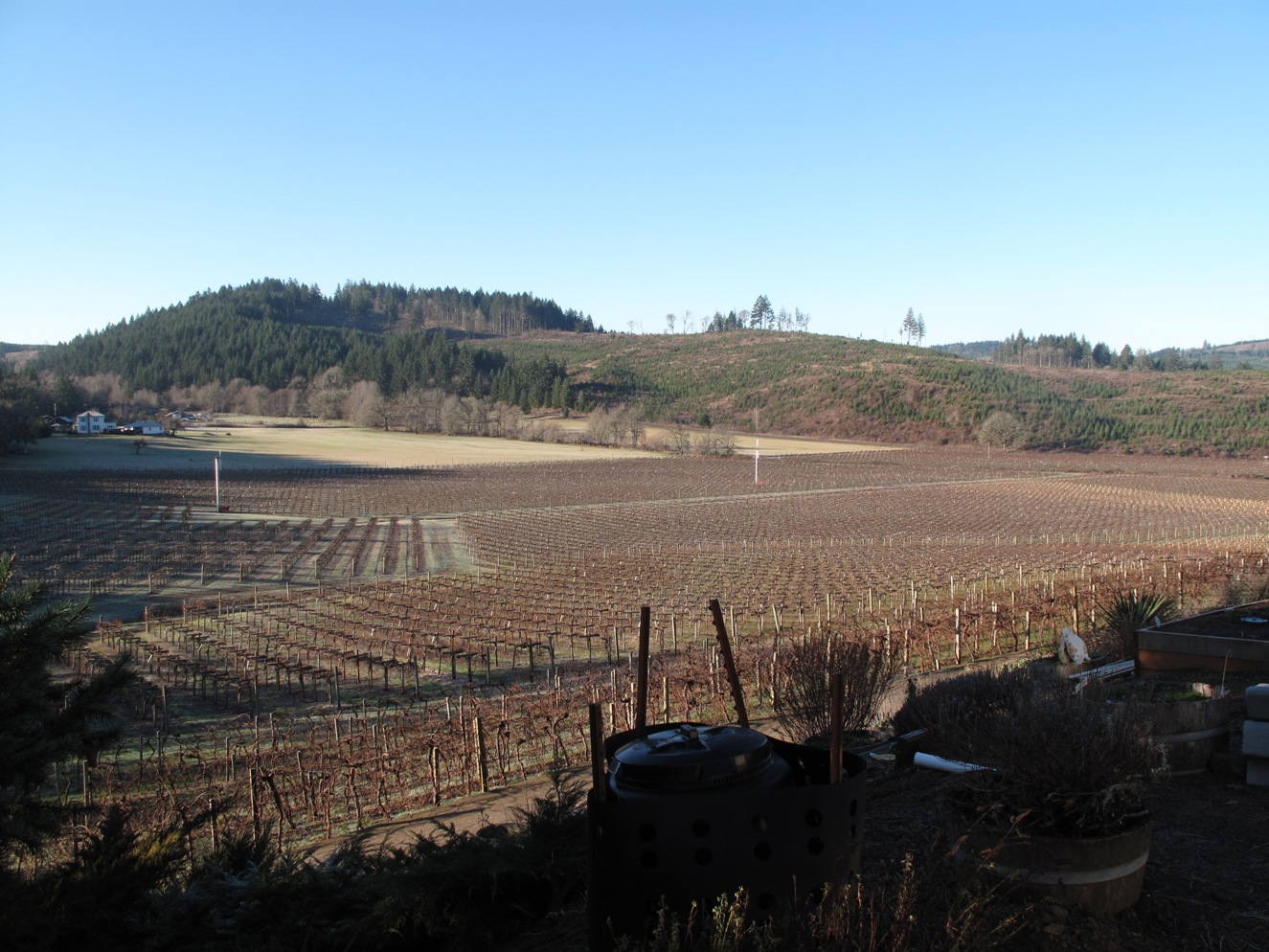
Pruning has started in the vineyard.  The crew at this time is just making the cuts, later when the vines are warmer they will go back and remove the dead wood and tie up the canes for this year.  If they tried to do it now the canes would tend to break as they are quite stiff from the cold and we would have nothing for this year.

I'm going to go pet my pump some more. 

Just kidding.

Or maybe not?

22 December 2011

Let ML's begin

Yes folks, it's that time of year again.  I've started tracking MLs on the Pinot noir using paper chromotography.  I haven't inoculated the Chardonnay or the Rosé yet, still waiting for the fermentations to finish is all the barrels, but I did get on the Pinot noir.  As a refresher, ML stands for malo-lactic, and is the secondary fermentation that wine can go through.  Not all wines go through ML though generally wines aged in barrels do.  Wine in stainless steel tanks can also go through ML but it seems to be less common.  Instead of a yeast fermentation, like primary fermentation, which converts the sugar to alcohol, this is a bacteria which converts malic acid, like that found in green apples, to lactic acid, found in milk.  The change in the type of acid causes a pH shift which combined with the different acid makes the wine taste softer and rounder.  Which is why winemakers have wine go through in ML.  This year the wines seem to have very high levels of malic acid and I am expecting to see a larger pH shift than normal.  We'll see if that is true.  After checking to see if the barrels had started on their own, they hadn't, I decided to inoculate. 
The ML bacteria comes freeze-dried and I allow it the rehydrate in water for 15 minutes before adding it to barrel, you can see it sitting in the plastic container in the upper right corner of the picture below.  I also add nutrients specific for the bacteria to each barrel which is the powder sitting on the scale.   Healthy bacteria combined with the right nutrients and a warm enough barrel room will hopefully get the fermentation off to a strong start and I'll soon be able to see activity in the barrels.  I enjoy checking on the wines while they are going through ML because the wine seems to sparkle and swirl all on its own when the bacteria is going strong.  I'll inoculate the Chardonnay and Rosé as soon as they are finished with primary fermentation, it is rumored that you can have both going at the same time but I've not had much luck with that so I prefer make sure the primary fermentation is done before trying to start the secondary.
As for primary fermentations, my reinoculated Pinot gris seems to be going, not very quickly and I have to warm it just about every other day but it's moving, i.e. the sugar is dropping, and that makes me happy.  The rest of the whites in the winery are finished and I'm just waiting on this last tank of Pinot gris to start blending trials for Seven.  I also need to start checking the wines for protein stability and cold stability.  I can't wait to get started!

20 January 2011

Winter in Oregon

I'm not sure what to write about this week.  I must admit that this is not my favorite time of year.  Short, dark days tend to make me sleepy and desirous of curling up in a ball on the couch and reading or stitching.  I do realize that we are well past the shortest day of winter and that the evenings are certainly staying light longer which does inspire me to do more about the house.  This week I cooked two very good meals, if I do say so myself.  Tuesday night we had a some beef and barley soup that I cobbled together from three recipes.  I still will have to work on that one but combined with my fresh rolls it was definitely effective at combating the cold outside.  Last night I made Chicken Cacciatore from Cooks Illustrated.  It came out well though I think it might have benefited from some kalamata olives.  I love hitting the little salty spots that olives create.  Tonight is leftovers so will see if either dish benefited from some melding in the fridge.  I might throw some olives in the Cacciatore just to see.

Back at the winery things are quiet.  I have been trying to run the chilling to cold stabilize the white wines to get them ready for filtering but the system has been a little uncooperative.  I came in one morning to see glycol foaming out of the top of its storage barrel and at the price of glycol even losing a little is not a good thing.  Added to this problem is that I am trying to chill small amounts of wine.  It seems like this should be easier but instead what happens is that there is not enough wine in contact with the coils that wrap around the tank so actually extracting the cold from the glycol is difficult and I have to be careful that I don't damage the tanks by letting the steel get too cold.  The glycol can actually cause the metal to shrink and buckle if it is allowed to get too cold.  So Mary and I are trying to monitor the temperature on the tanks, the glycol level in the storage barrel and chill the wines.  Mother nature was helping, we even had a few snow flurries and then it warmed up to 50F for a few days and dumped lots of rain even in the mountains which distressed the skiers and now we are back down to 35F.  I am surprised more of us aren't sick!  As far as for the reds I am still waiting for the last four barrels of pinot to complete ML and I have been catching up on my lab work checking SO2 levels, pH, acid levels and alcohols.

In the vineyard the guys are pruning in the rain, snow and sun, kind of like postmen.  You can see last years canes between the rows on the right.  Later when the ground has firmed up they will be mulched into the soil with the tractor.
One of my current stitching projects.

03 January 2011

Happy New Year!

A bright and shiny new year for us all.  I already have my fingers crossed for a better vintage but I have 9 or 10 months until I know what this year is bringing.  Not being a New Year Resolution type person I don't have any resolutions to talk about but as always I do have the goal to eat healthy and get more exercise.  End of discussion.  And you can just see the pond is freezing.  Maybe we'll get a day of skating again!
In the winery last week I added bentonite to remove the protein from the Pinot gris and Gewurztraminer.  I am going to check today to see if I added enough.  The effectiveness of bentonite is temperature dependent so while I try to keep the samples at the same temperature as the wine what worked in the lab doesn't always work in the winery.  Hopefully it did as we are having a bit of a cold snap, 22F as I was driving in this morning, and I can use mother nature to help me cold stabilize the whites.   I need to chill them down to about 32F and keep them there for a week or two until all the tartaric acid precipitates out.  Depending on the amount of tartaric acid this can cause an acid shift in the wine which this year might be a good thing as I find the wines a little tart.  
Last week, I also added SO2 to the barrels on Pinot noir that are finished with ML.  After adding the SO2 I stir the barrels to mix in the SO2 otherwise it tends to settle to the bottom and then I top the barrels before putting in the new bung.  You can see in the pictures the two types of bung I use.  One allows the barrel to outgas, important during ML and the new one is a solid bung which reduces the amount of oxygen getting in.  I still have a few barrels of pinot which haven't finished ML and I am waiting for them to poke along to the finish.  ML bacteria of course doesn't like these cold temperature so what didn't finish last week may now sit for a little while until the barrel room gets a little warmer, the bacteria would rather be at 60-65F rather than the 45F the barrel room is now. 
 Pruning is starting in the vineyard this week, cold temperatures are helping that too and of course for us it only gets this cold generally when it is clear so the sun is glorious right now.  A trade off and one I consider well worth it, I'm sure warmer weather and wetter days are on their way.

30 November 2010

ML Results

I just thought I would let you know that the ML sheets are looking good.  The Marechal Foch, first three columns on the left are finished, there is no dot in the middle, and will soon get sulfur.  The last two barrels of pinot noir, right edge of right page are done or almost done and they are closest to the heater.  Isn't it interesting what a little warmth can do.  I am going to put a heater in the middle of the row now to try and help everything else.

28 December 2009

Post Christmas, pre New Year

Sorry I didn't write last week, I did work but then decided to enjoy a few days off with my husband which did not involve updating my blog. On an exciting note, well for me anyway, all the Foch has finished ML. Isn't that a pretty picture. All those yellow dots up top and at the bottom and none left in the middle. I also ran aspirations to check the free SO2 in the port and the 2008 Dunn Forest Pinot noir in barrel. I always feel like a mad scientist when I have bubbling flasks. I have three barrels of DF, for you fans and that should be ready to drink in 2-3 years at the earliest. The SO2 (sulfites) are added to the wine to protect it against both oxidation and microbial infection. I have heard customers complain about headaches for sulfites, especially reds, in the tasting room but almost never are the sulfites to blame. Whites usually have more sulfites than red wines and the most commen alergic reaction is more of an asmatic repsonse rather than headachaes. Just something to keep in mind when your friend claims she can't drink red wine because of the sulfties.


This morning was back to work though, in the dark and cold! And I have to drudge 17 miles through the snow, up hill, both directions! Just kidding, though it was cold, my car said 25F, and that thin sheet of ice really kept it interesting. Because of the cold and clear sky the sun rise was quite pretty, I had to get a picture while making my coffee. Then I wondered around the winery admiring the frosty edges and there is ice on the pond!! If this weather keeps up maybe I'll get to go out again. I'm not holding my breath though. The cold has helped drive all the sap to the roots of the vines and pruning should start in the next few weeks. When the guys are done the vineyard and vines always look so neat and tidy. As far as work I stirred the Chardonnay barrels and ran a ML check on the Pinot noir and Chard barrels. We'll see if they are moving as well as the Foch. Keep your fingers crossed for me.

18 December 2009

Quiet Time

I had a very difficult time writing this week after all the excitement of last week. I kept waiting and waiting, hoping something might come along that was fun to talk about. And now here it is Friday evening and I figure reading about my doing data entry for a day has to be as bad as me writing about doing it and even worse than the actual data entry. No more on the subject and no more run on sentences.
Yesterday we got the newsletter out and that took most of the day. I am sorry that you couldn't see the pictures in the letter, I should have checked that first. It has something to do with the mailing program we use. I'll get it right for next time.
On a winemaking note I did do ML's early on in the week, see below if you want more information, and excitingly, for me at least, things are moving! About a 1/3 of my sample barrels are done and that is great for mid-December. Today I spent topping all the barrels (pinot, foch, chard) and stirring the chard. Things are looking and smelling good.
On the weather front, our ice is long gone, how sad, and we have had several days of fog, which has made it feel cold and damp and dark though admittedly it isn't particularly cold. I am however very ready for the short days to be getting longer, winter solstice isn't too far away. Yeah! I hope you all have a great weekend and enjoying getting ready for Christmas.

02 December 2009

Malo-lactic Fermentation

This week I am checking ML's for the first time. This is a two day process because after putting all the pretty little dots of wine on the lovely white paper I have to put the paper in a jar of chromatography solvent. It then sits for eight hours, the chromo solvent slowly working its way up the paper. The next step is to pull it out and let the paper dry over night and finally the next day the separated dots are ready to be read. Some of you might remember this from high school chemistry class. In our class, we put dots on the paper from various black felt tip pens and then looked at the separation of the colors that occurred. Ring any bells? In this case I use capillary tubes to put the dots on the paper. Ideally all the dots end up the same size and are well centered. Don't look at my dots too closely! ;-)
Everything in barrel gets checked for ML i.e. Chardonnay, Marechal Foch and Pinot noir. Hopefully everything will be done by the end of February but there are always a few lagging barrels. I am sure you will get to read about that later.
For those of you unfamiliar with ML: It is a bacteria fermentation rather that a yeast fermentation that coverts malic acid, like that found in green apples to lactic acid, like that found in milk. Winemakers tend to have wines which are to be barrel aged go through the process because of a shift in pH that occurs which increases mouth-feel and approachability in wines. Especially young wines are very tart, at least here in the Willamette Valley and this helps address that acidity. White wines made in tank and intended to be drunk chilled rarely go though ML. In whites I want that extra bit of brightness.